Chileno Valley Newt Brigade
Newsletter Archive

⬅️ June 2025
March 2024 ➡️

NewtNews Archive:
NewtNews — Issue #6, October, 2024

Laguna Lake on a "newt night", March 2024 (Photo by Sally Gale)
Welcome to NewtNews!
Issue #6  •  October 2024

Newt Brigade Five-Year Summary Statistics

Over the past five years, during migration season, our brigadiers have rescued more than 30,000 newts along our one-mile stretch of Chileno Valley Road, with the number of animals saved doubling each year. Additionally, many other amphibians and reptiles have been spared from being killed by vehicles.

The number of volunteers patrolling this stretch of road has grown annually, along with our understanding of amphibian behavior. The data we meticulously collect contributes to ongoing research and will ultimately support the construction of effective wildlife crossing structures.

While our long-term goal is to build a safer road for these tiny creatures to navigate, we remain focused on saving as many animals as possible. We understand this will likely be a long journey, but we are committed to seeing it through.

"The Chileno Valley Newt Brigade" film wins coveted award!
Filmmaker Lori Eanes presented her film, "The Chileno Valley Newt Brigade” to the Bernal Heights Outdoor Cinema on September 7th, 2024, and won  the "Best of Bernal” award. A good number of Brigadiers braved the cold to see the debut of this lovely 13-minute film. It was amazing to see us up on this huge screen!

This amazing film can be seen locally on the big screen at the
San Francisco Green Film Festival, Sunday October 20th 2024 at noon at the 4 Star Theater, 2200 San Clement St, San Francisco. Tickets are $15.00 at the box office.

Lori spent years making this polished film. We are greatly indebted to Lori's talent and dedication, and to Sharon Beals, who took charming close-up footage of the newts.

Lori Eanes & Mahina Gordon on Chileno Valley Road, 12/2023 (Photo by Sally Gale)

Some interesting data from last year ...
The figure above, based on the work of Rich Bessmer, our dedicated brigadier statistician, shows the relative number (%) of adult and juvenile newts encountered by brigadiers along Chileno Valley Road, which is divided into equal segments 1–25, running west to east.

These data are essential for determining the optimal locations for installing animal crossings. The graph also underscores the importance of the GPS data our brigadiers meticulously record for every animal they encounter.

When we began gathering data five years ago, we observed a significant concentration of newts in certain areas compared to others. Notably, segments 19-22, at the eastern end of the road, emerged as a preferred crossing zone, likely due to the proximity of a large wetland filled with reeds and clumps of grass.

Welcome Dr. Gary Buccarelli

We are happy to welcome Dr. Gary Buccarelli, Associate Adjunct Professor,
University of California, Davis; Department of Wildlife, Fish, and Conservation Biology

Gary is an Evolutionary Biologist specializing in amphibians. He will advise us on all things amphibian, analyze the dead newts we have been able to collect, and teach a class on Chileno Valley newts to U.C. Davis students this Fall.

Christyne Davidian and her Morning Crew collected dead newts from our section of Chileno Valley Road all last year for research. Gary and his university students will utilize these 300 frozen newts to better describe the unique population we have at Laguna Lake. 

With the help of a grant from the Tomales Bay Watershed Foundation, Gary will also lead a hands-on sexing study of our newts, which will determine the effects of climate change on their viability. Stay tuned!
Scenario 1: Full coverage elevated road segment (ERS) with 15 m passage spacing

How might the Chileno Valley Road crossing solution work?

Cheryl Brehme, Phillip Gould of USGS and Charles Tornaci of Dokken Engineering presented 8 different scenarios for built road crossings to the CVNB recently. 

The full 8 scenarios can be viewed here, but the fullest-featured/most comprehensive (and, of course, most expensive) version can be seen in the figure above ("Scenario 1"). 

In this "Cadillac" scenario, because the newts cross everywhere along the one-mile crossing area between Laguna Lake and the hillside above Chileno Valley Road, the crossings are placed every 15 meters along the whole road. Cheryl explained that crossings, probably culverts or underpasses, must have certain features for the newts to use them. These include light coming in from above, a smooth floor even with the crossing entrance and exit, a sufficiently wide passage, and other characteristics. Traffic safety, the weight of agricultural trucks, overhead power lines and land ownership are all limiting factors.

The figure below provides an example of the type of under-road construction being considered for Chileno Valley Road. The figure shows a cross-section of an under-road passage, featuring an elevated road to allow newts to enter the culvert at ground level, a grated lid to let light into the culvert from above, a level bottom designed to appeal to the newts, and an ample 30-inch minimum width.

Example of possible under-road amphibian passage (cross-section, Dokken Engineering)
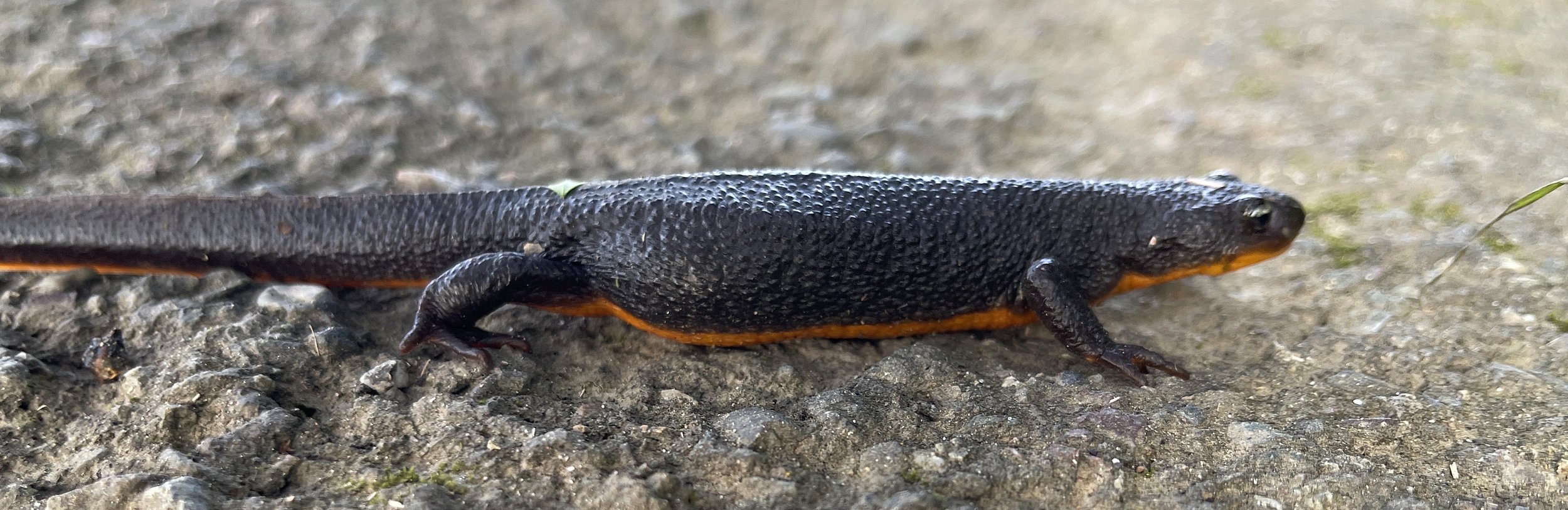
Juvenile Rough-skinned Newt – 11/2023
The Newt Brigade Needs Brigadiers!
It's mid-October and the Chileno Valley Newt Brigade has already begun its 6th season. Although 90% of our volunteers are back, we still need additional dedicated brigadiers to help us save the newts and other amphibians from the tires of cars and trucks hurtling down the road. The first part of the season is the most challenging, with sometimes thousands of baby newts to chase down. Seeing them is the first challenge; it is dark and they are small, blending in with the asphalt on rainy nights.
 
Please share this appeal with anyone you think might be able to help. Thank you!
Contact
Twitter
Facebook
CVNB Website
Instagram

Sign Up to receive our NewtNews newsletter